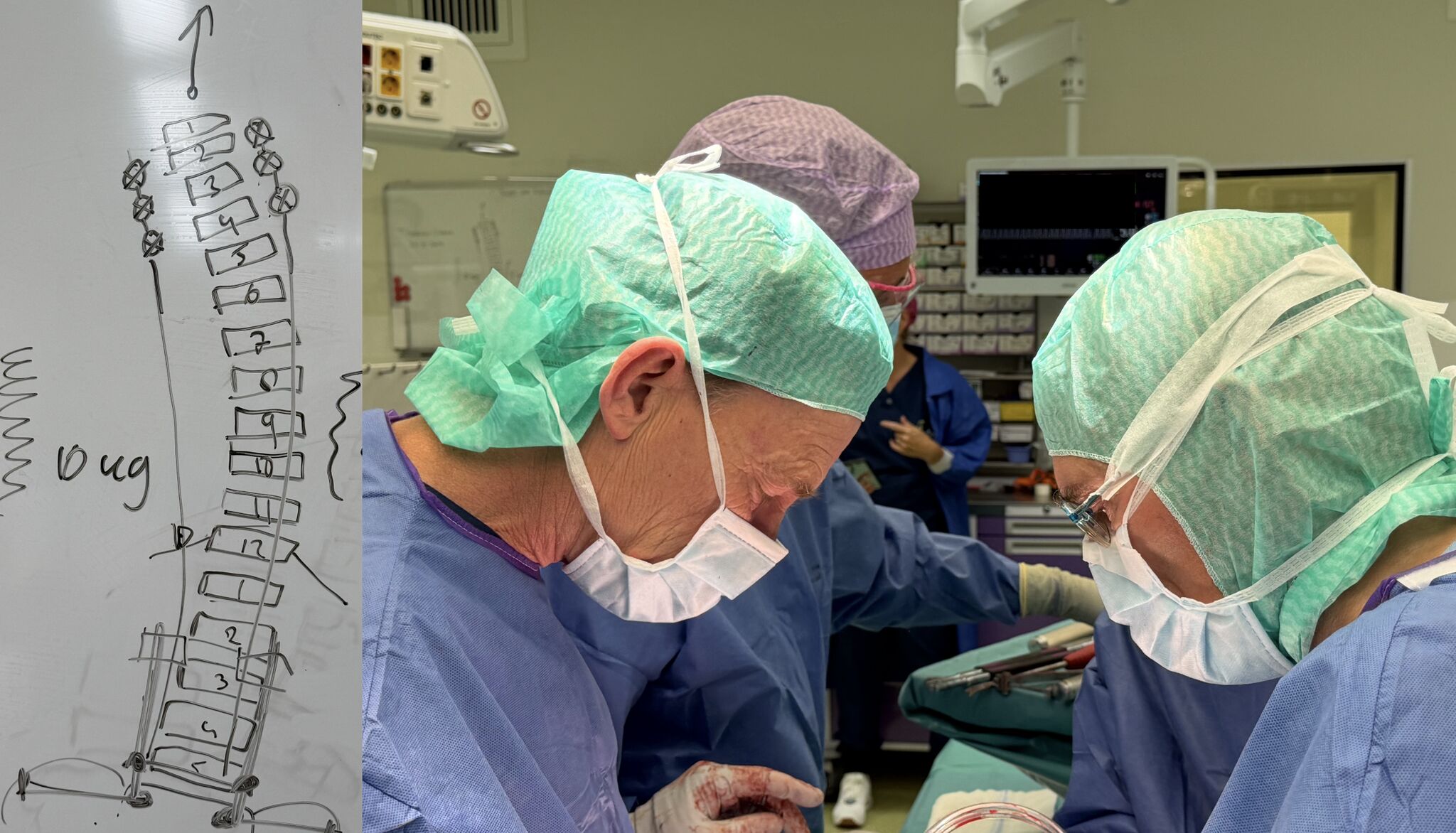
The first Spring Distraction System procedure in the US drew international attention. That moment was built on the data of more than 150 children treated in Utrecht since 2015.
Recently at Wilhelmina Kinderziekenhuis (Het WKZ), part of UMC Utrecht, the 160th child with Early Onset Scoliosis was treated with the Spring Distraction System (SDS) within the ongoing clinical study. Moyo Kruyt, one of the inventors of the system, performed the procedure together with Lodewijk van Rhijn and the pediatric spine team.
The foundation was laid in 2015, with one child and no suitable implant. A six-year-old with life-threatening progressive scoliosis caused by a thoracolumbar fusion mass. No CE-marked system available at the time could solve this problem.
European and Dutch medical device law reserves a route for exactly this situation. A non-CE-marked implant may be used in an individual patient when no approved alternative exists and the patient’s health is at stake. Inventors Moyo Kruyt and René Castelein treated that first child under this exemption, after ethics review, institutional approval and informed parental consent.
Safety had its own dossier. The hospital’s ISO 13485 certified medical technology and clinical physics department acted as manufacturer of the spring, led the design and manufacturing process, and compiled the investigational medical device dossier. A stack of paperwork for a single operation. The threshold is high, and it should be.
More children followed. The same rare, life-threatening deformities, the same absence of a suitable CE-marked option. An exemption covers one patient, it is not a route you repeat. So the team took the formal path: a prospective clinical study, reviewed and approved by the medical ethics committee, in which subsequent children could be treated with the investigational implant under a research protocol, with informed parental consent and predefined follow-up.
Every child since has been followed throughout the SDS treatment. Clinical observations became research questions. Complications led to design changes. Outcomes were separated by diagnosis instead of hidden inside an average. The data showed where the system performed well and where it needed work.
That program produced two doctoral theses, by Sebastiaan Wijdicks on the development of dynamic implants and by Justin Lemans on the biomechanical and clinical evaluation of spring-based treatment, plus dozens of publications and presentations at pediatric spine meetings.
The first United States procedure, performed by Amy McIntosh at Scottish Rite for Children, rests on that foundation. After the FDA granted Breakthrough Device designation, another two years of engineering and regulatory work went into 510(k) clearance.
For child number 160 with the ‘Utrecht’ SDS, the follow-up starts now. Same as it did for child number one in 2015.